Description
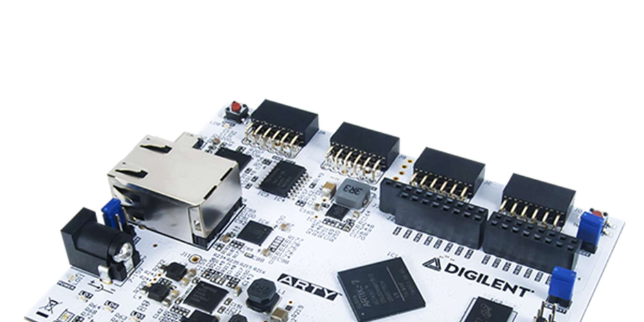
Arty Z7-10: APSoC Zynq-7000 Development Board for Makers and Hobbyists
Note for repeat customers: There has been a change to the Arty Z7-10 variant of this product. More information can be found in the RTL8211F and W25Q128JV PCN documents, available through the Support tab.
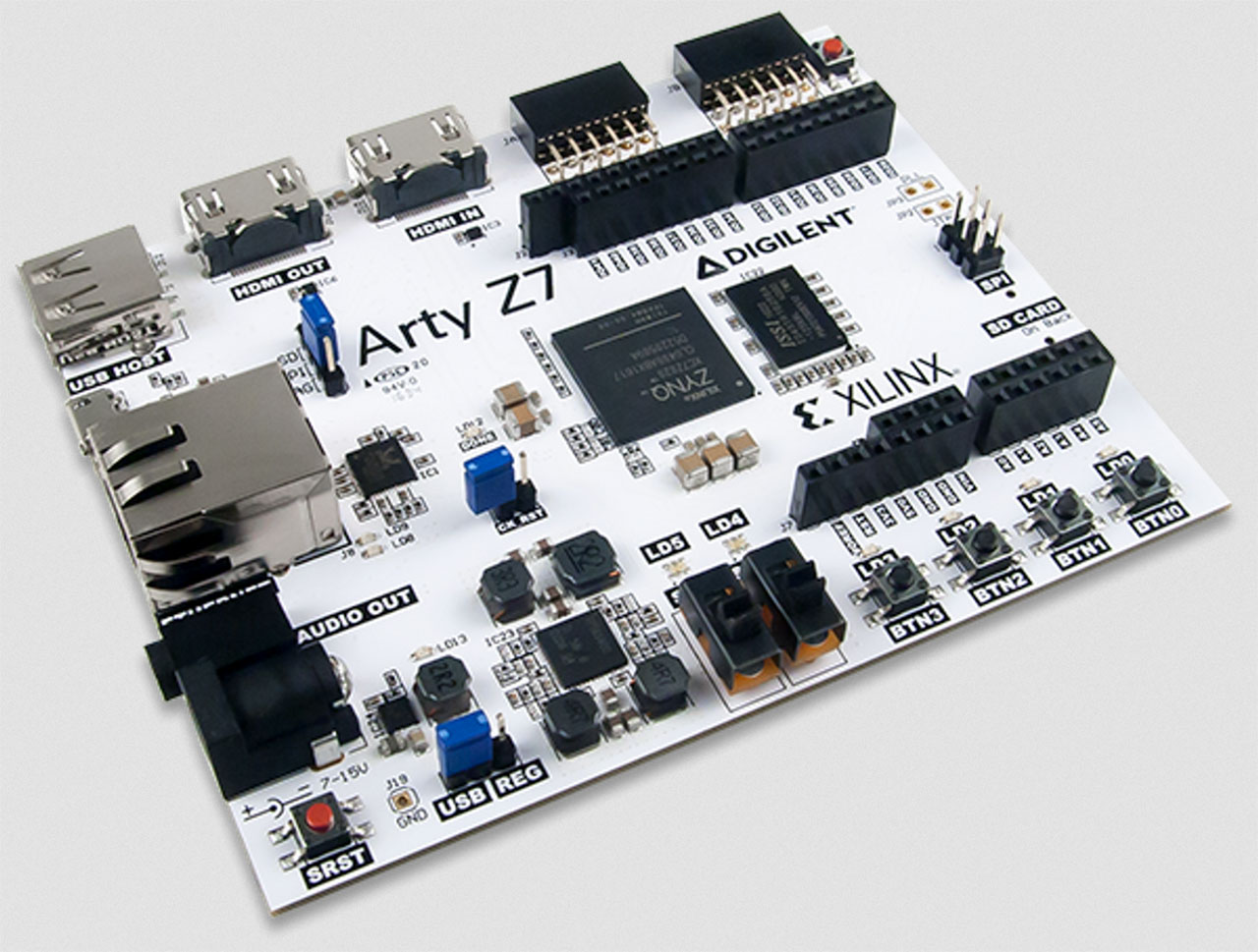
The Arty family of Digilent FPGA/SoC boards was designed with versatility and flexibility in mind. With universally popular Arduino? headers and multiple Pmod? ports, an Arty will be the most adaptable FPGA/SoC board in your toolbox.
The Arty Z7 is a ready-to-use development platform designed around the Xilinx Zynq?-7000 System-on-a-chip (SoC) family. The Zynq?-7000 SoC family integrates the software programmability of an ARM?-based processor with the hardware programmability of an FPGA, enabling key analytics and hardware acceleration while integrating CPU, DSP, ASSP, and mixed signal functionality on a single device.
The Arty Z7 is supported by Xilinx’s Vivado Design Suite, including the free WebPACK version. The SDSoC? Development Environment provides a familiar embedded C/C++/OpenCL application development experience for heterogeneous Zynq? SoC deployment.
There are two variants of the Arty Z7: The Arty Z7-10 features the XC7Z010-1CLG400C, and the Arty Z7-20 features the larger XC7Z020-1CLG400C. There is a third option available, the Arty-Z7-20 with a Xilinx SDSoC voucher, which is recommended for those interested in video processing applications.
If your application does not require the processing system of an SoC, the Arty A7, or Arty S7 may be better options.
Features
- FPGA Part: XC7Z010-1CLG400C
- Processor: Dual ARM Cortex A9
- Logic Cells: 28,000
- DSP Slices: 80
- Block RAM: 2.1 Mbits
- Available Shield I/O: 26
Specifications
ZYNQ Processor
- 650MHz dual-core Cortex-A9 processor
- DDR3 memory controller with 8 DMA channels and 4 High Performance AXI3 Slave ports
- High-bandwidth peripheral controllers: 1G Ethernet, USB 2.0, SDIO
- Low-bandwidth peripheral controller: SPI, UART, CAN, I2C
- Programmable from JTAG, Quad-SPI flash, and microSD card (Micro USB cable not included).
- Programmable logic equivalent to Artix-7 FPGA
Memory
- 512MB DDR3 with 16-bit bus @ 1050Mbps
- 16MB Quad-SPI Flash with factory programmed 48-bit globally unique EUI-48/64™ compatible identifier
- Due to supply chain constraints, the SPI Flash has been replaced by the Winbond W25Q128JV starting with revision D.0. This part is not functionally equivalent to parts used on older revisions, but flash programming through Vivado and the QSPI boot mode are not affected. More information can be found in the “Product Change Notice – Flash Memory” document, which can be found in the Arty Z7 Resource Center.
- microSD slot
Power
- Powered from USB or any 7V-15V external power source
USB and Ethernet
- Gigabit Ethernet PHY
- Due to obsolescence, the Realtek RTL8211E has been replaced by the Realtek RTL8211F starting with revision D.0. These parts are not functionally equivalent, but the capabilities of the Ethernet port are not affected. More information can be found in the “Product Change Notice – Ethernet PHY” document, which can be found in the Arty Z7 Resource Center.
- USB-JTAG Programming circuitry
- USB-UART bridge
- USB OTG PHY (supports host only)
Audio and Video
- HDMI sink port (input)
- HDMI source port (output)
- PWM driven mono audio output with 3.5mm jack
Switches, Push-buttons, and LEDs
- 4 push-buttons
- 2 slide switches
- 4 LEDs
- 2 RGB LEDs
Expansion Connector
- Two standard Pmod ports
- 16 Total FPGA I/O
Arduino/chipKIT Shield connector
- Up to 26 Total FPGA I/O (see table above)
- 6 Single-ended 0-3.3V Analog inputs to XADC
- 4 Differential 0-1.0V Analog inputs to XADC
Resources & Downloads
All product support including documentation, projects, and the Digilent Forum can be accessed through the product resource center.
- Reference Manual (off-site)
- Schematic (.pdf)

Reviews
There are no reviews yet.